Treat box maker
Treat box template
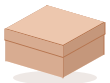
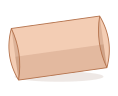
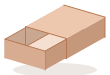
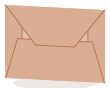
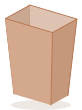
A four-wall tube with a tuck bottom and a top that closes with a round tongue through a slit. Choose the curved or the tuck closure, then set the width, depth and height.
How to fold it
Print at 100% on cardstock and cut the outline, then the slit across the back flap; a metal ruler keeps it straight.
Crease only the straight folds. The tongue's curve is cut, not scored, so it bends by hand when you shape it.
Roll the four walls into a tube and glue the grey tab inside the far wall.
Close the bottom: fold in the dust flaps, then the bottom lid, and tuck its flap inside the wall.
Fill the box, then fold the two short dust flaps on each side wall under where the top flaps will lie.
Bring the back flap down, lay the front flap over it, and push the round tongue's tip through the slit.
How the template is drawn
The tongue
The round tongue is 13.4 mm (0.53 in) deep at 2.5 × 1.5 × 3 in: at most 70% of the back flap's depth, half its chord and 30 mm, whichever is least.
Arc radius
The tongue's edge is a circular arc of radius 28.6 mm (1.12 in), running 48.5 mm (1.91 in) between two points set in from the side walls.
The slit
The slit is 38.3 mm (1.51 in) long: the tongue's width halfway down it, plus 1.5 mm. It sits 6.7 mm (0.26 in) in from the back flap's free edge.
Dust flaps
Each side wall carries two short dust flaps, 19.2 mm (0.75 in) deep and never more than 45% of the width, which tuck under the top flaps. A 2 mm gap separates each pair in the middle.
Bottom tuck
The bottom closes like a tuck end box. Its tuck flap is 23 mm (0.91 in) deep and 0.8 mm (0.03 in) narrower than its lid on each side, so it slides in without catching.
Tuck flap option
Choose “Tuck flap” to close the top like a tuck end box instead. Both closures need at least 20 mm of width and depth, and the tongue and slit appear only for the curved one.
Party favors, wedding favors and candy
A treat box holds candy, a few sugared almonds, a small gift or a bath bomb for a party table or a wedding. Cut it from patterned card, or print the lid in one colour and the front with a guest's name. For a Cricut, Silhouette or laser, load the SVG: the cut lines and the score lines sit on separate layers, in millimeters, and the tongue's curve is smooth. Set the score lines to score.
A flat gift travels better in a pillow box, and a tuck end box holds a bar of soap. For sweets on a table, the treat cone is quicker, and a window box lets the favor show through its front.
On 300 gsm card the tongue is stiff, so push its tip through the slit with a fingernail rather than bending the whole flap; thinner paper slides in easily but holds less, and a small sticker over the tip seals a favor shut. For a guest list, put each name on the front and an initial on the top flap. A cutting machine cuts the slit in one pass; by hand, cut it with a craft knife against a metal ruler and keep its ends square.