House box maker
House box template
A tube of four walls with a peak at each end, a two-panel roof and a tuck bottom. Keep the door and windows or choose plain walls, then set the width, depth and wall height.
Ready-made sizes
Inside sizes from the maker's published size, plus room to slide it in.
LED tea light house
1.89 × 1.89 × 1.97 in 48.1 × 48.1 × 50.1 mm
House box. From 1.5 in tall, 1.5 in across (a battery LED tea light)1; room added: 10 mm across and 12 mm in height, so the light stands clear of the walls; never put a flame in paper.
How to fold it
Print it at actual size on the paper you picked, with scaling turned off in the print dialog.
Cut the outline, then the door and window openings with a craft knife, starting each one inside a corner.
Score every dashed fold, the four short roof tab folds included, and fold each one once.
Roll the four walls into a tube and glue the grey tab inside the plain end wall, the one without a window.
Drop a battery tea light in through the open bottom, then close the floor with its dust flaps and tuck flap.
Fold both roof panels down until they meet at the ridge, and glue each of the four roof tabs inside a gable.
How the template is drawn
Ridge and roof panels
The roof lifts the ridge 21.4 mm (0.84 in) above the wall tops at 2.5 × 2 × 2.5 in, half the depth times the tangent of 40°. Each panel runs 33.3 mm (1.31 in) from eave to ridge.
Roof tabs
Each panel ends in a tab 11.7 mm (0.46 in) wide, never more than 35% of the panel's length. The tabs are cut back at the eave and the ridge to match the gable's angles, so each lies flat inside its gable.
Floor and tea light
The bottom is a tuck flap 30 mm (1.18 in) deep with dust flaps 25.5 mm (1 in) deep. The tea light goes in from below before the floor closes. Battery only, never a flame.
Door and windows
The door is 15.3 mm (0.6 in) wide and 31.9 mm (1.25 in) tall, centred on the front wall. Each window is a square 10.6 mm (0.42 in) on a side: at most a fifth of the wall height, and a sixth of the house's width.
Where the windows go
The front gets a window either side of the door when it is wide enough, the back gets two above the floor's tuck flap, and the right gable gets one. The left gable has none, because the glue tab lies inside it.
Shape limits
The depth can run from half to 1.5 times the width, and the wall height from half to 1.4 times the larger side. The Even, Tall and Long shapes set the proportions for you.
Christmas villages and tea light houses
Glue vellum or tracing paper behind each window, from the inside, and a tea light below makes it glow. Choose “Plain walls” for a solid house with no openings. Several sizes set in a line make a village; a little white card on each roof reads as snow.
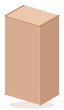
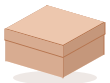
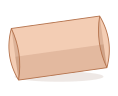
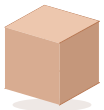
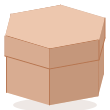
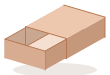
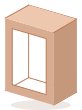
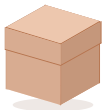
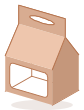
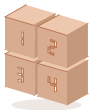
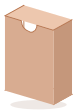
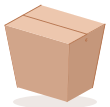
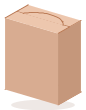
For a plain keepsake with a slip-on top, use the box with lid. A window box shows a small figure on a shelf, a gable box carries a sweet by the handle, and a cube net is the simplest square of the same size.
Other boxes





Sources
- Christmas Central, Set of 3 Battery Operated LED Flickering Amber Lighted Gold Christmas Tea Light Candles 1.5", read 2026-10-10: “Candle measures 1.5" high by 1.5" diameter … Each candle requires 1 "CR2032" button cell batteries, included”