Octahedron maker
Octahedron template
Eight equal triangles meeting at six corners, the shape of two square pyramids joined base to base. Choose the edge length, then print the net to fold it.
How to fold it
Print on cardstock at 100%, then measure one side with a ruler before you cut: it should match the size on screen.
Cut round the outline, grey tabs included unless you picked No tabs.
Crease every dashed line with a ruler and a dry ballpoint, folding each one back and forth once.
Fold the triangles up along their creases, one at a time, until the faces start to close round the middle.
Glue each grey tab inside the face next to it, then press each of the six corners with a thumb until the glue sets.
How the template is drawn
Faces, edges, corners
Eight faces, twelve edges and six corners. 6 − 12 + 8 = 2, the same count that holds for any solid with flat faces and no holes.
Surface area
Eight equal triangles that together cover twice the square root of 3 times the edge squared. At 2.5 in that is 139.7 cm² (21.65 sq in).
Volume inside
The square root of 2 divided by 3, times the edge cubed. At 2.5 in the solid holds 120.7 cm3 (7.37 cu in).
Fold angle
Two faces meet at 109.5° inside the solid. Each tab folds through what is left of a half turn, 70.5°, which is less than a right angle.
Opposite faces
Opposite faces are the two that share no corner. On the d8 they add up to 9, so 1 sits opposite 8, 2 opposite 7, 3 opposite 6 and 4 opposite 5.
Crystals, pyramids and d8 dice
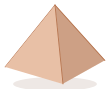
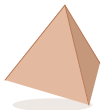
An octahedron is two square pyramids placed base to base, which is why the two shapes look so alike. Four faces meet at each of its six corners, so every corner looks alike. Fluorite often grows in octahedral crystals, and natural diamonds frequently form octahedra before they are cut, so the shape turns up often in minerals.
The d8 is the octahedron of tabletop games, with eight faces to roll and its numbers set so that opposite faces sum to 9. The octahedron is also the dual of the cube: join the centers of a cube's six faces and you get an octahedron, and join the centers of the octahedron's eight faces and you get a cube. A cube net is the easiest place to see that pairing.
Classroom activity: print the net at two sizes, measure one face on each and work out the surface area from the formula. Doubling the edge should make the area four times as large, not two, and the volume eight times as large. Then set a square pyramid beside it: its shape is exactly half of this solid. Its four triangles at a corner sit between the tetrahedron, with three at each point, and the icosahedron, with five; a hexagonal pyramid meets six at its tip.