Pyramid box maker
Pyramid box template
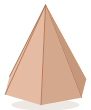
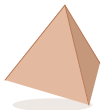
A square base and four triangles that lean in and meet at a point. Set the base and the height; the slope follows.
How to fold it
Print at 100% and cut out, keeping the narrow tab on one edge of each triangle.
Crease the four base edges and the tab creases.
Fold the four triangles up.
Glue each tab inside the next triangle, one at a time, pinching the tip together.
For a pyramid that opens, glue three tabs and leave the fourth triangle loose as a door.
How the template is drawn
Slant height
Each triangle is as tall as the square root of height² + (base ÷ 2)²: 65.7 mm (2.58 in) at 2.5 × 2.25 in.
Lean
Each side meets the base at 61°, the angle whose tangent is twice the height over the base.
Tabs that hide
The tabs are 8 mm (0.31 in) deep and cut inside each triangle's corner angles, so they stay hidden in the next face even on a tall, narrow pyramid.
Tab fold
Each tab folds by the angle between two neighbouring sides, 76.4° here, so it lies flat against the next side.
Range
The height can run from a fifth of the base (a low roof) to four times the base (a spire).
Pyramids in class and on the table
In a geometry lesson, measure the slant height on the printed net and check it against the formula above. Then count: five faces, eight edges and five corners, and 5 − 8 + 5 = 2, as Euler's formula says for every solid of flat faces. Its volume is a third of the base times the height, so three pyramids of sand fill a box with the same base and height. The Great Pyramid of Giza stood about 0.64 times as tall as its base is wide: a base of 4 in and a height of 2.55 in make a model of it. As a favor box, leave one side unglued and tie it with a ribbon.
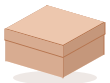
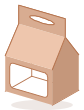
For a solid with square faces, try the cube net; for a peaked box with a handle, the gable box. Gifts that need a flat top go in a box with lid or a tuck end box.
Volume is the base times the base times the height, divided by three, so a square pyramid holds exactly a third of a box with the same base and height. A classroom can prove it with rice: fill the pyramid, pour the rice into a cube of that base and height, and it takes three pyramids to fill the cube. The surface is the base squared plus two times the base times the slant height, which is the area the printed net covers. The faces of the Great Pyramid of Giza rise at about 51.8°, a steady slope that has stood for thousands of years. Your net is a square with four isosceles triangles: the two long sides of each triangle are equal, so the four faces lean in by the same amount and meet at one tip. Keep every measurement in the same unit, or the volume will come out wrong by a large factor.