Envelope pouch maker
Envelope pouch template
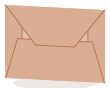
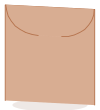
An envelope that opens into a shallow box. Type the inside width, depth and height: the gusset is drawn round the sides and bottom, and the lid tucks in without glue.
How to fold it
Print at 100% on 160 to 220 gsm cardstock, then measure one side with a ruler: it should match the size on screen.
Cut along the solid outline only. The corner squares are creased, not cut, so nothing can slip out at the corners.
Crease every dashed line, including the diagonal and the two middle lines in each corner square, folding each one both ways.
Stand the two side gussets and the bottom gusset up from the front, and fold each corner square into its pleat.
Glue the tab on each side gusset to the inside of the back, which is already joined to the bottom gusset.
Fill it, fold the lid over and tuck its flap down inside the front. To store it flat, push the gussets in along their middle creases.
How the template is drawn
Gusset depth
The gusset is 19.3 mm (0.76 in) deep: the depth you type plus one board. At 5 × 0.75 × 3.5 in that is 0.76 in (19.3 mm).
Corner pleats
Each gusset has a crease down its middle, 9.6 mm (0.38 in) from either edge, so it folds in flat. Each corner square is as big as the gusset's depth, creased on its diagonal and both middle lines; opened, it lies flat against its side gusset.
Glue tabs
The back is joined to the bottom gusset and glued onto a tab on each side gusset, 7.7 mm (0.3 in) wide.
Lid and tuck flap
The lid is as deep as the gusset. Its tuck flap is 22.3 mm (0.88 in) deep, a quarter of the height and kept between 10 and 40 mm. It pushes down inside the front with no glue, so the pouch opens again.
Stores flat
Pressed flat with the lid open, it measures 5.01 in (127.3 mm) by 3.51 in (89.3 mm), the size of its front. That fits a drawer or a bigger envelope for mailing.
Gusset limit
The gusset can be at most half the width and half the height, so a pouch that expands still folds flat.
Thick cards, booklets and small gifts
Put a thick card with an insert, a small booklet, a wedding invitation suite or a bundle of photos in an envelope pouch. A flat card with nothing else fits an envelope better, and a small favor that is flat belongs in a favor pouch.
Use 160 to 220 gsm cardstock for a sturdy pouch, or kraft card for a plain look that still bends at the creases. Checked folded both open and pressed flat, it stores in a drawer. For a gift that sits on a table, a sliding drawer box or a tuck end box may suit better, and a gift bag is the choice for a handle.