Icosahedron maker
Icosahedron template
Twenty equal triangles in one zigzag strip, five above and five below. Enter the edge length and the strip folds into a solid with twelve corners.
How to fold it
Print the strip at 100% on cardstock, then measure one side with a ruler: it should match the size on screen.
Cut round the zigzag outline. Keep the grey tabs if you chose glue tabs.
Crease every dashed line between neighboring triangles, folding each one back and forth once.
Fold the strip into a ring of ten triangles, then join its two ends and glue them on the inside.
Fold the five triangles above the ring in toward the top and the five below in toward the bottom, then glue or tape each join from inside.
How the template is drawn
Faces, edges, corners
Twenty faces, thirty edges and twelve corners. 12 − 30 + 20 = 2, and the total is always 2 for a solid like this.
Surface area
Twenty equal triangles, each a quarter of the square root of 3 times the edge squared, so the total is five times the square root of 3 times the edge squared. At 1.75 in that is 171.1 cm² (26.52 sq in).
Volume inside
Five times three plus the square root of 5, divided by twelve, times the edge cubed. At 1.75 in it holds 191.6 cm3 (11.69 cu in).
Fold angle
Two faces meet at 138.2° inside the solid, the widest angle of the five regular solids. So each tab folds only 41.8° to lie flat inside the next face.
Five per corner
Five triangles meet at each of the twelve corners. Their 60° angles add up to 300°, less than a full turn, so the corners can close into a near-round solid.
Viruses, domes and d20 dice
An icosahedron has the most faces of the five regular solids, and its triangles wrap a ball more evenly than any of the others. Many viruses, adenovirus among them, build their protective shell from identical protein units arranged on an icosahedron, so one kind of unit can close the whole case. Its twelve corners are the points where five triangles meet, which is why the solid looks so round from a distance.
Geodesic domes start from the same idea: split each triangle into smaller triangles and the flat pieces bend into a near sphere, which is how many greenhouses and exhibition halls are built. The d20 of tabletop games is an icosahedron numbered 1 to 20, with opposite faces adding up to 21. Its dual is the dodecahedron, so the two shapes swap faces and corners.
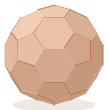
Classroom activity: predict before printing what happens when the edge doubles. Surface area grows by four and volume by eight. Then print the net at 0.9 in and again at 1.8 in, and check both figures against the formulas. A soccer ball is an icosahedron with its corners cut off, which is why it has twelve pentagons. Fewer triangles make the octahedron and the tetrahedron, the other two regular solids with triangle faces, and the cube net completes the family of five.