Crash-lock bottom box maker
Crash-lock bottom box template
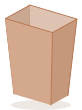
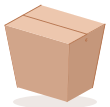
A tube of four walls, a tuck top and a floor of four flaps. Glue two small webs once, fold the box flat for shipping, and the bottom swings into place when you open it.
How to fold it
Print at 100% on cardstock, 250 gsm or heavier if the box will carry real weight. Leave fit-to-page off.
Cut the outline, including the four floor flaps and the two grey webs on the front and back flaps.
Crease the dashed lines, and score the two 45° lines the webs hinge on so the floor folds flat later.
Bring the long edges together into a tube and glue the tab behind the far wall. Hold the corners square while it sets.
Fold the four floor flaps in, spread glue on each web and press it onto the flap beside it. Flatten the box.
To set it up, open the tube and let the floor swing into place. Fill it, then close the top with its dust flaps and lid.
How the template is drawn
Floor reach
At 3 × 2 × 4 in, each floor flap runs in 25.5 mm (1 in): half the shorter side, so the flaps meet along 45° lines from the corners.
Flap shapes
A box wider than it is deep gets trapezoids on its front and back and triangles on its sides. A deeper box flips that, and a square box gets four triangles.
Glue webs
Each web is 15 mm (0.59 in) deep, along the 45° edge of its flap. It is glued onto the flap beside it, so it never touches a wall.
Tuck top
The top's tuck flap is 30 mm (1.18 in) deep and its dust flaps reach 25.5 mm (1 in). Both can be changed under Settings.
Tuck clearance
Each side of the tuck flap is trimmed back by 0.8 mm (0.03 in), so the flap slides down inside the walls instead of catching on the corners.
Glue tab
The tube's glue tab is 15 mm (0.59 in) wide and lands on the inside of the far wall, so the outside stays clean.
Shipping, stock and flat storage
A crash-lock bottom suits product boxes and heavier contents that a tuck bottom would sag under. Because the box folds flat once its webs are glued, you can print a stack ahead of time and open each one in a single movement when it is needed.
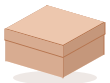
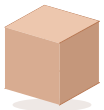
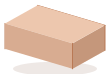
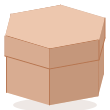
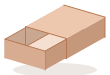
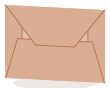
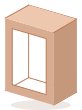
For a box that ships on its own, the mailer box lays its floor out with slots instead of flaps. A smaller item that needs no floor support fits a tuck end box, and a square gift with the same clean look is a cube net. For a second piece that slides over the top, the box with lid is the usual partner.
Packaging makers call it a crash lock because on a packing line the flat box is pushed open and its bottom crashes into place with no hand inside. At home, try it before filling: open the tube, press the floor once from inside so the flaps seat against each other, then load from the top, setting heavy things down flat rather than dropping them in. To store the box again, squeeze two opposite corners: the floor folds back up into the tube and the box lies flat.