Cylinder net maker
Cylinder net template
A rectangle exactly as long as the circumference, with a circle above and below its middle. Type the diameter and the height, and the net redraws to size.
How to fold it
Print on cardstock or regular paper with scaling off, then measure the printed diameter against the number you typed.
Cut round the rectangle and both circles. Include the teeth on the circles only for glue tabs.
Roll the rectangle into a tube, printed side out. There is no crease along the tube: the paper bends round on its own.
Glue the strip on one end under the other end, from the bottom up, and hold it for a few seconds.
Bend each circle's teeth inside the tube and glue each one to the wall. With no tabs, tape each circle to the inside instead.
Stand the tube upright until the glue sets, so both circles sit square to the wall.
How the template is drawn
Surfaces and edges
Three surfaces: two flat circles and one curved side. Two curved edges, where the side meets each circle, and no corners. Euler's formula is for solids with flat faces, so it does not count this one.
Surface area
Two circles of area pi (3.1416) × r², plus the side, which unrolls to a rectangle pi × diameter long and the height tall. At 2 × 4 in the total is 202.7 cm² (31.42 sq in).
Volume inside
One circle's area times the height: pi × r² × h. At 2 × 4 in it holds 205.9 cm3 (12.57 cu in).
Rectangle length
The rectangle is exactly as long as the circumference, so the tube wraps the circle with no gap: 159.6 mm (6.28 in) at 2 × 4 in. The glue strip is 8 mm (0.31 in) wide.
Teeth on the circles
The teeth sit on the circles so each end has a surface to glue inside the wall. There are 10 per circle, on every other side, each 6 mm (0.24 in) deep.
Cans, tubes and rolled posters
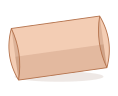
A cylinder is two circles joined by one curved side. Its net is a rectangle with a circle above and below it, and the rectangle is as long as the circle's edge all the way round. The paper bends into the tube without a crease along it. Archimedes showed that a sphere fits exactly inside a cylinder of the same width and height, and that the sphere takes two thirds of the cylinder's volume.
Cans, mailing tubes and rolled posters are all cylinders, and a tall tube and a short drum use the same two formulas. The Even, Tall and Short shapes set the proportions quickly, and you can type any diameter and height over them. For a tube that wraps round a bottle or a roll of tape, choose “No tabs” and close the seam with tape.
Classroom activity: wrap a strip of paper round a can, mark where it overlaps, and measure the can's width with string. Multiply that width by 3.14 and compare the length with the rectangle on the printed net; the two should be close. A treat cone is a cylinder's cousin that closes to a point, and a wine bottle box uses the same round tube to hold a 750 ml bottle. Swap the circles for hexagons and the same idea gives a hexagonal prism or a hexagon box; stand a cube net beside it to compare a square end with a round one.