Soccer ball maker
Soccer ball template
Twelve pentagons and twenty hexagons in one piece, laid out to print as large as a Letter or A4 sheet allows. Type an edge length and the drawing resizes to match.
How to fold it
Print on heavy paper or card with scaling turned off. The net fills one sheet, so measure one edge to check the size.
Color the twelve pentagons now, before you cut, while the whole net still lies flat.
Cut along the outline, keeping the tabs if you picked glue.
Score every line between two faces, then fold each crease sharply so it sits flat.
Fold the faces toward the center. At every corner two hexagons and one pentagon should meet, so check each corner as you go.
Apply glue to each tab and press it into the face it meets, a few at a time, and close the last gap with the final tab.
How the template is drawn
Faces, edges, corners
32 faces: 12 pentagons and 20 hexagons. 90 edges and 60 corners, so 60 − 90 + 32 = 2. Every corner joins two hexagons and one pentagon.
Surface area
Twenty hexagons and twelve pentagons, each measured on its edge, added together. At 0.7 in the total is 229.5 cm² (35.58 sq in).
Volume inside
About 55.288 times the edge cubed, from (125 + 43 × the square root of 5) ÷ 4. At 0.7 in the ball holds 310.8 cm3 (18.96 cu in).
Angles between faces
Two hexagons meet at 138.19° inside the ball, and a hexagon meets a pentagon at 142.62°. The net is flat, so each fold makes up the rest of 180°: 41.81° between hexagons and 37.38° at a pentagon.
Finished size
The finished ball is about 4.96 times its edge across. At 0.7 in that is 88.2 mm (3.47 in).
Panels, buckyballs and domes
The soccer ball is a truncated icosahedron. Take a twenty-sided solid and cut off each corner a third of the way along every edge: the twelve corners become pentagons and the twenty triangles become hexagons. The classic 32-panel ball is that pattern. The same arrangement of atoms forms the C60 molecule, nicknamed the buckyball after Buckminster Fuller, who designed geodesic domes.
Geodesic domes use the same logic: many flat panels, each a small part of a sphere, meet along edges to make a rounded shell. A soccer ball is a small example of the idea. Its faces are simple shapes, and the curve comes from how they are arranged, so pentagons and hexagons together let the panels bend round with only small gaps.
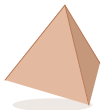
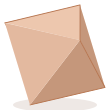
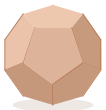
Classroom activity: before folding, color the twelve pentagons in one color and the hexagons in another. Fold the ball, then count the faces at one corner. It should be two hexagons and one pentagon, and every other corner follows the same pattern. An icosahedron is the solid this one is cut from, and the dodecahedron uses twelve pentagons with nothing else. Simpler solids of flat faces to fold first: the octahedron and the tetrahedron.