Chinese takeout box maker
Chinese takeout box template
An oyster pail: a small floor, four walls that lean out and a top that folds shut. The pint and quart sizes are ready-made, or type your own pail's measurements.
Ready-made sizes
Inside sizes from the maker's published size, plus room to slide it in.
Takeout pint (16 oz)
3.75 × 2.88 × 3.25 in 95.3 × 73 × 82.6 mm
Chinese takeout box. From 3 3/4 × 2 7/8 in at the top, 3 × 2 1/8 in at the bottom, 3 1/4 in tall (a 16 oz paper pail)1; room added: none: this is the pail's own size.
Takeout quart (32 oz)
4.5 × 3.88 × 4.25 in 114.3 × 98.4 × 108 mm
Chinese takeout box. From 4 1/2 × 3 7/8 in at the top, 3 3/8 × 2 5/8 in at the bottom, 4 1/4 in tall (a 32 oz paper pail)2; room added: none: this is the pail's own size.
How to fold it
Print at 100% on cardstock. Pick the pint or quart size above, or type your own measurements.
Cut the outline, including the two small round holes in the end walls for the wire handle, 3.2 mm across.
Score the four edges of the floor lightly, so each wall bends out along its own line.
Fold the front and back walls up, turn their slanted glue tabs inside, and glue them to the end walls.
Fold the end walls up over the tabs and hold each corner until the glue grips. The pail now leans out.
Fill it, fold the two ears on each end in, then the back flap, then the front flap with its tongue slid under the back one.
How the template is drawn
Opening and floor
The width and depth you type are the opening, measured inside the rim. The floor is smaller than that: 2.9 in (73.7 mm) by 2.03 in (51.5 mm) at 3.75 × 2.88 × 3.25 in.
Wall lean
Each wall leans out 10.8 mm (0.42 in) over its height, which is 7.4° from upright. The lean is 13% of the height at most and never more than 17% of the narrower top side.
Length of a wall
Measured along its slope, each wall runs 83.5 mm (3.29 in) from floor to rim.
Glue tabs
The tabs on the slanted edges of the front and back walls are 12 mm (0.47 in) wide, so they glue inside the end walls.
Ears and tongue
Each end wall carries two ears, 25 mm (0.98 in) deep, with a gap in the middle for the wire. The front flap's tongue is 22 mm (0.87 in) deep.
Hole position
The wire holes sit 8 mm (0.31 in) below the rim, centered on each end wall. Pick “No holes” in the tool for plain end walls.
Measuring a pail and what to put in it
To copy a pail you own, measure the top inside the rim, wide and deep, and the height from floor to rim. The floor is always smaller than the opening, so do not measure it from the top. Type the top and the height, and the tool works out the rest.
The pint pail (16 oz) is 3 3/4 by 2 7/8 in across the top, 3 by 2 1/8 in on the floor and 3 1/4 in tall. The quart (32 oz) is 4 1/2 by 3 7/8 in across the top, 3 3/8 by 2 5/8 in on the floor and 4 1/4 in tall.
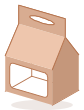
Paper pails for real food are coated. A printed one is for dry treats, favors and party take-home boxes. For a wider open tray, try the popcorn box; for a cone of sweets, the treat cone; for a carry handle, the gable box; and for a closed box, the tuck end box.
Other boxes






















Sources
- WebstaurantStore, Fold-Pak 16 oz. Pagoda Chinese / Asian Paper Take-Out Container with Wire Handle, read 2026-10-10: “Height: 3 1/4 Inches … Top Length: 3 3/4 Inches … Top Width: 2 7/8 Inches … Bottom Length: 3 Inches … Bottom Width: 2 1/8 Inches … Capacity: 16 oz.”
- WebstaurantStore, Fold-Pak 32 oz. Pagoda Chinese / Asian Paper Take-Out Container with Wire Handle, read 2026-10-10: “Height: 4 1/4 Inches … Top Length: 4 1/2 Inches … Top Width: 3 7/8 Inches … Bottom Length: 3 3/8 Inches … Bottom Width: 2 5/8 Inches … Capacity: 32 oz.”