Tetrahedron maker
Tetrahedron template
One large triangle, split into four, folds into a solid with four corners and four faces. The net redraws to whatever edge length you enter.
How to fold it
Print the net at 100% on any paper. A scaled print changes every edge, so measure one side with a ruler before cutting: it should match the size on screen.
Cut round the outside of the big triangle, and the grey tabs if you chose glue tabs.
Crease the three inner lines that join the midpoints of the big triangle's sides. Together they outline the middle triangle.
Fold the three outer triangles up over the middle one, so their tips meet above its center.
Glue each grey tab inside the face beside it, one at a time, and press each one for a few seconds.
With Dice (d4), a roll is the number at the corner that points straight up, so read the top point.
How the template is drawn
Faces, edges, corners
Four faces, six edges and four corners. 4 − 6 + 4 = 2. Euler's formula says the total must be 2 for a solid like this.
Surface area
Four equal triangles that together cover the square root of 3 times the edge squared. At 3 in that is 100.6 cm² (15.59 sq in).
Volume inside
The edge cubed, divided by six times the square root of 2. At 3 in it holds 52.1 cm3 (3.18 cu in).
Fold angle
Two faces meet at 70.5° inside the solid. The net lies flat at 180°, so each tab folds through the rest of the turn: 109.5°.
Its own dual
Join the centers of the four faces and the shape you get is another tetrahedron, smaller and upside down. Of the five regular solids, only the tetrahedron does this.
Molecules, dice and early cartons
A tetrahedron is the simplest solid with flat faces: four corners, each joined to the other three, and all six edges the same length, so one measurement sets the whole net. A methane molecule has its four hydrogen atoms at the corners of one, with a carbon atom at the center, and its bonds meet at about 109.5°, the same angle as the fold on this net.
A d4 is this solid with a number at each corner, and the roll is the corner that points up. The numbers sit near each corner on the three faces round it, so you can find every one before you cut. The early Tetra Pak cartons were tetrahedra too, which is where the name comes from. Choose “No tabs” for tape, or the “Dice (d4)” layout when you want a die you can roll.
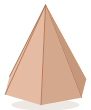
Classroom activity: print the net at two edge lengths, predict the volume ratio, then check it with the formula. Doubling the edge should multiply the volume by eight, not two. A tetrahedron also fits inside a cube net, touching four of its corners, and the octahedron is the next solid with triangle faces. Set it beside a square pyramid or a hexagonal pyramid to compare bases of three, four and six sides; a triangular prism has the same triangle at each end. Then fold a dodecahedron to see how far the family goes.