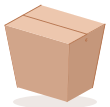
Pentagonal and hexagonal prism maker
Hexagonal and pentagonal prism template
A strip of six walls, or five, with an end shape hinged to the middle wall. Set the edge of the end shape and the height, and the strip follows.
How to fold it
Print on cardstock with scaling turned off. Pick Hexagonal or Pentagonal before you print, since the two nets have different strips.
Cut round the outside: the strip, both ends and their glue tabs. Keep the narrow tab on the closing edge of the strip.
Crease the lines between the walls, then the top and bottom edges of the middle wall, where the two ends hinge.
Fold the walls into a tube and glue the closing tab inside the first wall, so the tube stands square.
Fold one end in along its hinge and glue its tabs inside the walls, one tab at a time.
Fold the other end in the same way. Press each tab for a few seconds, then let the box stand until the glue grips.
How the template is drawn
Faces, edges, corners
8 faces, 18 edges and 12 corners for the hexagonal box: 12 − 18 + 8 = 2. A pentagonal prism has seven, fifteen and ten, since an n-sided prism always has n + 2 faces, 3n edges and 2n corners.
Surface area
Twice the area of one hexagon, plus six walls, each one edge long and one height tall. At 1.25 × 3 in that is 197.5 cm² (30.62 sq in).
Volume inside
End area times the height. At 1.25 × 3 in it holds 199.6 cm3 (12.18 cu in).
Where the walls meet
Neighboring walls meet at 120° in a hexagonal prism and at 108° in a pentagonal one, so each crease folds by 60° or 72°. Each glue tab is 7 mm (0.27 in) deep and folds down inside a wall; one more tab closes the strip.
Apothem
For the hexagon, the apothem runs from the center of an end to the middle of one side. It is 27.5 mm (1.08 in) at 1.25 × 3 in: the edge times the square root of 3, divided by 2.
Honeycombs, hex nuts and quartz
A hexagon fills a flat surface with no gaps, which is why honeycomb cells are hexagonal prisms with one end open. Hex pencils, hex nuts and bolt heads share the six-sided outline, so a hexagonal box holds a row of them snugly. Quartz crystals often grow as a hexagonal prism capped with pyramids.
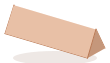
The pentagonal net has five walls and a pentagon at each end, so its strip is narrower. At the same edge, the hexagonal end has about half again the area of the pentagonal one. Only the number of sides changes between the two nets, so a student can compare them one wall at a time. The Pentagon office building in Arlington, Virginia, has a pentagonal outline, which makes the shape easy to find on a map. For a three-sided prism with its own tuck ends, see the triangular prism box.
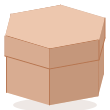
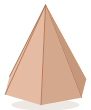
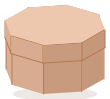
Classroom activity: cut both nets at the same edge and height. Before you fold, predict which box holds more, then check the prediction with the end-area formula. A hexagon box uses the same six-sided base with a slip-on lid, and a hexagonal pyramid box closes the same shape to a point. With round ends and a smooth wall it becomes a cylinder net.