Dodecahedron maker
Dodecahedron template
Twelve regular pentagons laid out as two flowers of six, joined petal to petal. Set the size you need, and the drawing follows.
How to fold it
Print at 100% on cardstock. A slightly scaled net looks normal by eye, so measure one side with a ruler before cutting: it should match the size on screen.
Cut round both flowers, including the grey tabs if you chose glue tabs.
Crease every dashed line with a ruler, then fold each one back and forth once.
Fold the first flower into a shallow cup: its center pentagon becomes the floor, and the five pentagons round it stand up.
Fold the second flower the same way, bring the two cups together along their rims, and glue each tab inside its neighbor.
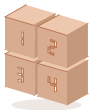
With Dice (d12), read the top face. Its 6 and 9 carry a full stop, so a 6 cannot be taken for a 9 when the die turns.
How the template is drawn
Faces, edges, corners
Twelve faces, thirty edges and twenty corners. 20 − 30 + 12 = 2. Euler's formula requires that total to be 2 for a solid like this one.
Surface area
Twelve regular pentagons that together cover three times the square root of 25 plus 10 times the square root of 5, all times the edge squared: about 20.6 times the edge squared. At 1.25 in that is 208.1 cm² (32.26 sq in).
Volume inside
Fifteen plus seven times the square root of 5, divided by four, times the edge cubed: about 7.66 times the edge cubed. At 1.25 in it holds 245.3 cm3 (14.97 cu in).
Fold angle
Two neighboring faces meet at 116.6° inside the solid. The flat net has them at 180°, so each tab folds through the difference, 63.4°: a shallower fold than the cube's 90°.
Three per corner
Three pentagons meet at each of the twenty corners. Their three 108° angles add up to 324°, which leaves a 36° gap, and that gap is what lets each corner close.
Calendars, Roman objects and dice
Twelve faces make a dodecahedron a natural calendar, with one month on each face. A cube net has only six faces, enough for half the year. Each face of this solid is a regular pentagon, and every petal on the net has the same edge as the center, so one edge length sets the whole drawing. Once the faces are glued, the solid keeps its shape without a frame. Small hollow Roman dodecahedra, often bronze, have been dug up in several parts of the old empire, and nobody knows for certain what they were used for.
The d12 of tabletop games is this solid with the numbers 1 to 12, and opposite faces add up to 13. Pyrite crystals sometimes grow with pentagon faces, though not regular ones. The dodecahedron is also the dual of the icosahedron: join the centers of its twelve faces and you get the corners of an icosahedron.
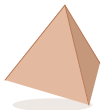
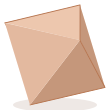
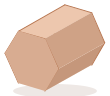
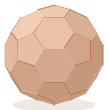
Classroom activity: measure one edge and one diagonal of a pentagon on the printed net, then divide the diagonal by the edge. The answer is close to 1.618, the golden ratio. A soccer ball has twelve pentagons too, though its other faces are hexagons. For a first fold before this one, the tetrahedron needs only four faces and the octahedron eight; a hexagon box shows how six-sided faces lie flat where pentagons cannot.